


Herbs for Healthy Skin: The Science Behind Skin Health From Within

Understanding how plant compounds, nutrition and lifestyle may support healthy skin
At Captivate Clinic, we believe healthy-looking skin is about more than what we apply to the surface.
Skin health is influenced by what happens both inside and outside the body. Nutrition, hydration, sleep, stress, hormones, environmental exposure, genetics, skincare and lifestyle all contribute to how our skin looks, feels and functions.
Nature also provides an extraordinary range of biologically active compounds. Many herbs contain polyphenols, flavonoids, carotenoids, essential fatty acids, vitamins and other phytochemicals that have been investigated for their antioxidant, anti-inflammatory and skin-supportive properties.
However, there is an important distinction between a plant containing a potentially beneficial compound and proving that consuming or applying that plant will produce a particular cosmetic result.
At Captivate Clinic, we believe in looking at both sides: the traditional knowledge surrounding natural ingredients and what modern scientific research can actually tell us.
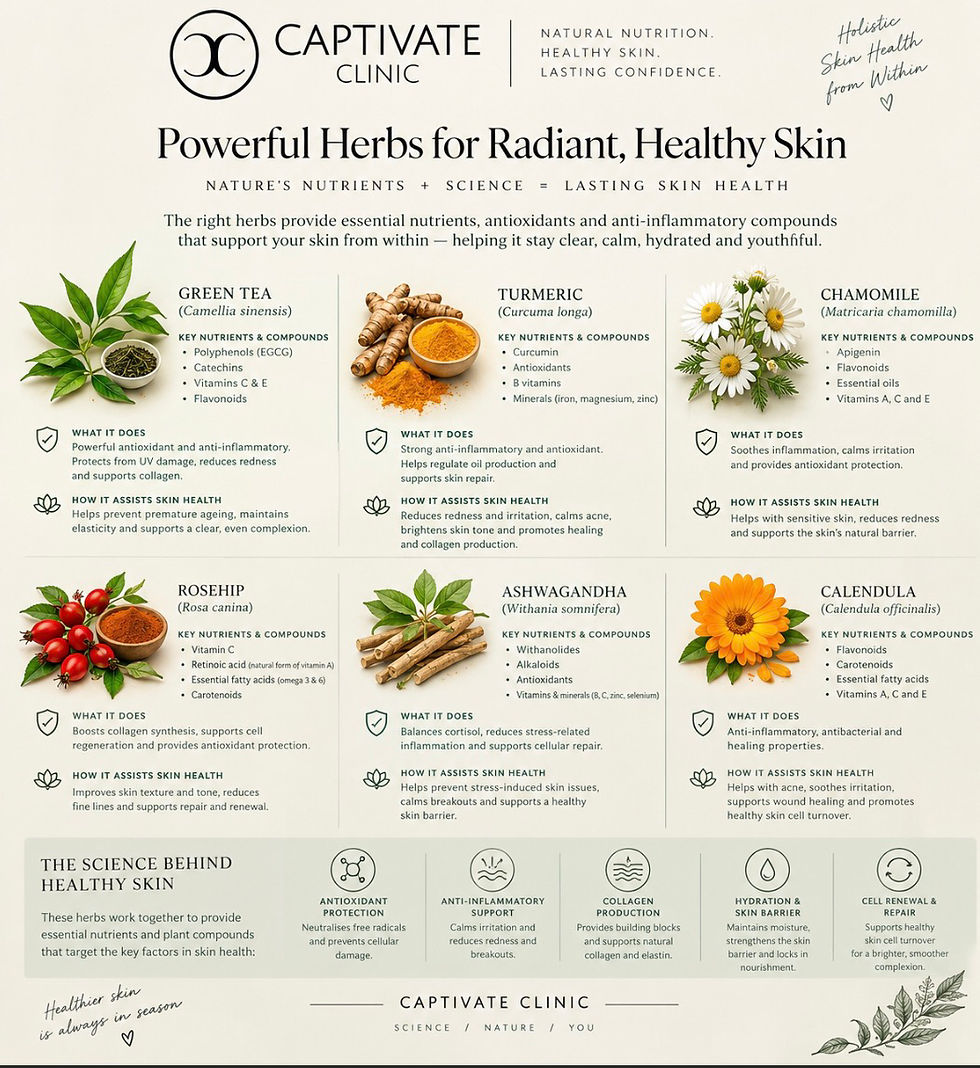
This article explores six herbs that are particularly interesting in relation to skin health:
Green tea
Turmeric
Chamomile
Rosehip
Ashwagandha
Calendula
What Does “Skin Health From Within” Mean?
Your skin is a living, functioning organ. It provides a physical barrier between your body and the external environment, helps regulate temperature, reduces water loss and participates in immune defence.
Maintaining healthy skin requires many different biological processes to work effectively.
These include antioxidant protection, collagen formation, skin barrier function, balanced inflammatory responses and normal cell renewal.
Antioxidant protection
Our cells naturally produce reactive molecules as part of normal metabolism. Environmental factors such as ultraviolet radiation and pollution can also contribute to oxidative stress.
The body has its own antioxidant defence systems, while many plant foods provide additional antioxidant compounds.
Collagen formation
Collagen provides structural support within the skin.
Adequate nutrition is important for normal collagen production. Vitamin C, for example, is required for normal collagen formation.
Skin barrier function
The skin barrier helps keep moisture in while protecting the body from environmental irritants.
A compromised barrier can contribute to dryness, sensitivity and discomfort.
Normal inflammatory processes
Inflammation is a normal part of the body's defence and repair mechanisms. However, excessive or persistent inflammation can contribute to various skin concerns.
Cell renewal and repair
The skin is continually renewing itself. Adequate nutrition, circulation and overall health support these normal processes.
This is why we cannot look at one nutrient, one herb or one skincare ingredient in isolation.
1. Green Tea
Camellia sinensis
Green tea is one of the most extensively researched botanical beverages and contains a group of compounds called catechins.
One of the best-known is epigallocatechin gallate, commonly known as EGCG.
Key compounds
Green tea contains:
Catechins
EGCG
Polyphenols
Flavonoids
Other naturally occurring plant compounds
Why are these compounds interesting?
Polyphenols are widely studied for their antioxidant activity.
Research has investigated green tea compounds in relation to oxidative stress, inflammation and the biological processes involved in skin ageing.
Ultraviolet radiation can contribute to oxidative stress within the skin, which is one reason researchers have been interested in whether green tea compounds could have protective properties.
However, laboratory findings cannot automatically be translated into a guaranteed cosmetic benefit from drinking green tea.
How may green tea support skin health?
Green tea can form part of a healthy dietary pattern by providing naturally occurring polyphenols.
Potential areas of interest include:
Antioxidant support
Supporting overall nutritional wellbeing
Research into oxidative stress
Research into inflammatory pathways
Potential applications in topical skincare
The important distinction
Drinking green tea is not equivalent to applying a concentrated green tea extract to the skin.
The concentration, formulation, absorption and method of delivery can all change how a compound behaves.
Captivate perspective: Green tea is a simple example of how everyday dietary choices can provide beneficial plant compounds, but it should complement rather than replace appropriate skincare and sun protection.
2. Turmeric
Curcuma longa
Turmeric has been used traditionally for centuries and is particularly recognised for its distinctive golden-yellow colour.
One of its best-known compounds is curcumin, which belongs to a group of compounds called curcuminoids.
Key compounds
Turmeric contains:
Curcumin
Other curcuminoids
Polyphenols
Other naturally occurring plant compounds
Why is curcumin being studied?
Curcumin has attracted considerable scientific interest because of its antioxidant and anti-inflammatory activity observed in laboratory and experimental research.
Researchers have investigated its effects on a variety of biological pathways.
This has generated interest in whether turmeric and curcumin could have applications in skin health.
How may turmeric support skin health?
Its potential relevance relates to:
Antioxidant activity
Research into inflammatory pathways
Traditional use in natural health
Potential topical applications
However, research into a biological mechanism does not necessarily mean that taking a turmeric supplement will visibly improve an individual's skin.
Food versus supplementation
This distinction is particularly important with turmeric.
Using turmeric as a culinary spice is very different from consuming a concentrated curcumin supplement.
Some supplements are specifically formulated to increase the absorption of curcumin. Concentrated products can have stronger biological effects and may also carry greater risks.
Some people may experience digestive symptoms, and there have also been reports of liver injury associated with certain highly bioavailable curcumin products.
Captivate perspective: Natural does not automatically mean risk-free. Anyone considering concentrated herbal supplements should consider their medications, health history and individual circumstances and seek appropriate professional advice.
3. Chamomile
Matricaria chamomilla
Chamomile is traditionally associated with calming and soothing properties and is commonly consumed as a tea.
It is also found in various topical preparations.
Key compounds
Chamomile contains:
Flavonoids
Apigenin
Other plant compounds
Naturally occurring volatile components
Why is chamomile relevant to skin?
Chamomile has traditionally been used to soothe irritated skin.
Some of its plant compounds have demonstrated biological activity in laboratory research, and topical chamomile preparations have been investigated for various skin applications.
However, the quality and strength of evidence varies depending on the preparation and the condition being studied.
Potential skin-supportive properties
Chamomile is particularly interesting for:
Soothing formulations
Skin comfort
Traditional topical use
General wellbeing and relaxation
A note about sensitive skin
Even natural botanical ingredients can cause irritation or allergic reactions.
People who are allergic to plants in the daisy family may need to take particular care with chamomile.
Captivate perspective: “Natural” should never be used as shorthand for “suitable for everyone.” The individual skin and the formulation always matter.
4. Rosehip
Rosa species
Rosehip is the fruit of certain rose plants and is used in foods, teas, oils and supplements.
It has become particularly popular in skincare because of its naturally occurring fatty acids and plant compounds.
Key nutrients and compounds
Rosehip can contain:
Vitamin C
Carotenoids
Polyphenols
Essential fatty acids
Other naturally occurring plant compounds
The nutritional composition varies depending on the species, preparation and processing method.
Vitamin C and collagen
Vitamin C is particularly relevant to skin health because it is required for normal collagen formation.
Collagen provides structural support within the skin.
This does not mean that consuming a rosehip product will automatically increase collagen or reverse visible ageing.
It means that obtaining adequate vitamin C as part of a nutritionally adequate diet supports a normal biological process involved in collagen formation.
Rosehip oil
Rosehip seed oil is different again.
Rather than primarily providing vitamin C, the oil contains fatty acids and other lipid-soluble plant compounds and is commonly used in topical skincare.
It may help condition and moisturise the skin depending on the formulation and individual skin type.
Captivate perspective: Rosehip demonstrates why the form of an ingredient matters. A rosehip fruit, rosehip tea, rosehip supplement and rosehip seed oil are not interchangeable products.
5. Ashwagandha
Withania somnifera
Ashwagandha is a traditional Ayurvedic herb that has attracted significant modern research interest.
It contains naturally occurring compounds known as withanolides.
Key compounds
These include:
Withanolides
Other naturally occurring plant constituents
Ashwagandha is commonly discussed in relation to stress, sleep and general wellbeing rather than as a direct skin treatment.
Why might stress matter to skin?
The relationship between stress and skin is complex.
Stress can influence:
Sleep
Hormonal signalling
Behaviour
General wellbeing
Perception of skin concerns
Some people notice changes in their skin during periods of increased stress.
This has led researchers to explore the relationship between the nervous system, hormones, immune processes and the skin.
Could ashwagandha improve skin?
There is currently not enough high-quality evidence to describe ashwagandha as a proven treatment for acne, wrinkles, pigmentation, eczema or skin ageing.
Its potential relevance is more indirect, through its investigation as a stress-supporting botanical.
Safety is particularly important
Ashwagandha is not appropriate for everyone.
It may interact with medications and may be unsuitable for people with certain medical conditions. It is also generally advised against during pregnancy and breastfeeding.
There have been reports of liver injury associated with ashwagandha products.
Captivate perspective: Supporting wellbeing can be an important component of holistic health, but supplements should never be selected simply because they are marketed as “natural.”
6. Calendula
Calendula officinalis
Calendula, sometimes known as pot marigold, has a long history of traditional topical use.
It is found in creams, ointments and other preparations designed to soothe and condition the skin.
Key compounds
Calendula contains:
Flavonoids
Carotenoids
Essential oils
Other plant compounds
How may calendula support skin?
Calendula has traditionally been used for:
Skin soothing
Skin comfort
Topical conditioning
Supporting the care of irritated skin
Research has explored calendula in various topical applications, although evidence for specific medical or cosmetic outcomes remains variable.
Captivate perspective: Calendula is another example of why the finished formulation matters.
The presence of calendula in a skincare product does not automatically mean the product will produce a particular result. Concentration, formulation and the individual's skin all influence the outcome.
The Nutrients Behind Healthy Skin
While herbs can provide interesting plant compounds, healthy skin depends on a much broader nutritional foundation.
Vitamin C
Vitamin C contributes to normal collagen formation and also has antioxidant functions.
Sources include:
Citrus fruits
Berries
Capsicum
Kiwi fruit
Broccoli
Leafy vegetables
Protein
Protein provides amino acids needed for normal tissue maintenance and repair.
Sources include:
Eggs
Fish
Meat
Dairy
Legumes
Nuts and seeds
Soy products
Essential fatty acids
Dietary fats are important components of cell membranes and overall nutrition.
Sources include:
Nuts
Seeds
Oily fish
Avocado
Plant oils
Zinc
Zinc contributes to normal skin maintenance and many other physiological processes.
Sources include:
Meat
Seafood
Dairy
Legumes
Nuts and seeds
Vitamin A
Vitamin A is involved in normal cell differentiation and skin function.
Sources include both animal foods containing preformed vitamin A and plant foods containing carotenoids that the body can convert to vitamin A.
More is not necessarily better. Excessive supplementation of certain forms of vitamin A can be harmful.
Antioxidants and Skin Ageing
“Antioxidant” has become a popular term throughout the beauty and wellness industry.
However, antioxidant science is considerably more complex than simply saying:
More antioxidants equal better skin.
The human body already has sophisticated antioxidant defence systems.
Plant-derived antioxidants may interact with biological pathways in different ways, and their effects can depend on dose, formulation, absorption and metabolism.
A varied diet containing fruits, vegetables, legumes, whole grains, nuts and seeds is a practical way to obtain a broad range of nutrients and plant compounds.
Rather than focusing on one “superfood” or “super herb”, a diverse nutritional pattern is generally a more sustainable approach.
Collagen and Skin Structure
Collagen is one of the major structural proteins in the skin.
As we age, collagen production and the organisation of the extracellular matrix change. Environmental factors, particularly ultraviolet exposure, can also contribute to changes in collagen and other components of the skin.
Nutrition provides some of the building blocks and cofactors involved in normal collagen metabolism.
Vitamin C is particularly important because it is required for normal collagen formation.
However, nutrition alone cannot completely prevent the natural biological changes associated with ageing.
This is why skin health should be approached from multiple angles.
Hydration and the Skin Barrier
Healthy-looking skin also depends on an effective skin barrier.
The outermost layers of the skin help minimise water loss while protecting against external irritants.
Supporting the skin barrier may involve:
Adequate fluid intake
Appropriate moisturisation
Gentle cleansing
Avoiding unnecessary irritants
Choosing skincare appropriate for your individual skin
Botanical oils can assist with skin conditioning in some formulations, but a natural or plant-derived ingredient is not automatically appropriate for every skin type.
Why Natural Does Not Always Mean Better
One of the most important principles in holistic health is understanding that natural and effective are not synonymous.
A natural substance can still:
Cause an allergic reaction
Irritate the skin
Interact with medication
Affect the liver
Affect hormones or other biological pathways
Be unsuitable during pregnancy
Be inappropriate for certain health conditions
Likewise, a synthetic ingredient is not automatically harmful.
The more useful questions are:
Is it appropriate?
Is it evidence-informed?
Is it safe for this individual?
Is the formulation appropriate?
Is the potential benefit worth the potential risk?
These are the questions that help separate responsible natural health education from exaggerated wellness claims.
Food, Tea, Topical Products and Supplements Are Different
The same herb can behave very differently depending on how it is prepared and used.
Food
Herbs and spices used in cooking are generally consumed in relatively small amounts as part of a meal.
Tea
Tea extracts compounds from the plant into water. The resulting composition depends on the plant, quantity, preparation and steeping time.
Topical skincare
A cream, serum or oil is formulated specifically for application to the skin.
Its effects depend on the entire formulation rather than simply the presence of one botanical ingredient.
Concentrated supplements
Supplements can contain much higher concentrations of specific compounds.
Consequently, they may have different biological effects and different safety considerations.
Never assume that because something is safe as a food, it is automatically safe in concentrated supplement form.
How Strong Is the Evidence?
When evaluating natural skin health claims, it is helpful to understand the different levels of evidence.
Traditional use
A plant has been used for generations for a particular purpose.
This provides valuable historical knowledge but does not prove clinical effectiveness.
Laboratory research
A compound demonstrates an effect in cells or experimental models.
This can help researchers understand potential mechanisms but cannot guarantee the same result in humans.
Human research
The intervention is studied in people.
This provides more relevant evidence, although study quality, dosage, formulation and duration still matter.
Strong clinical evidence
Multiple high-quality human studies consistently demonstrate a meaningful benefit.
This is where we can have greater confidence in a particular claim.
Many botanical skin health claims remain somewhere between traditional use, laboratory research and early human research.
That is why responsible education should avoid exaggerated promises.
Can Herbs Replace Skincare or Medical Treatment?
No.
Herbs may complement a healthy lifestyle, but they should not replace:
Daily sun protection
A balanced diet
Appropriate skincare
Medical assessment of persistent skin concerns
Prescribed treatment when clinically indicated
Professional advice regarding supplements and medication interactions
If someone has acne, rosacea, eczema, pigmentation or another ongoing skin concern, the appropriate approach depends on the underlying cause.
A botanical supplement may not address that cause.
A holistic approach means considering the whole person while still respecting the importance of evidence-based healthcare.
Sun Protection Remains Essential
When discussing skin health and ageing, nutrition is only one part of the conversation.
Ultraviolet radiation is a major environmental contributor to skin damage and premature skin ageing.
A comprehensive approach to skin health should therefore include appropriate sun protection.
This may include:
Broad-spectrum sunscreen
Protective clothing
Hats
Shade
Avoiding unnecessary prolonged exposure when UV levels are high
No herb, food or supplement should be promoted as a substitute for sensible sun protection.
Practical Ways to Support Your Skin From Within
Eat a varied, nutrient-rich diet
Include a wide range of fruits, vegetables, legumes, whole grains, nuts, seeds and protein sources.
A diverse diet provides a broad range of vitamins, minerals, essential fats and plant compounds.
Use herbs as food where appropriate
Green tea, turmeric and other culinary herbs can be enjoyable additions to a balanced diet.
You do not need to take a concentrated supplement to have a healthy diet.
Prioritise adequate protein
Protein provides amino acids required for normal tissue maintenance and repair.
Stay adequately hydrated
Hydration is an important part of general health and contributes to maintaining normal physiological function.
Protect your skin from the sun
Consistent sun protection is one of the most important strategies for reducing UV-related skin damage.
Choose skincare carefully
The right products depend on your individual skin, concerns and tolerance.
Be cautious with supplements
Before taking an herbal supplement, consider:
Your medications
Your health history
Pregnancy or breastfeeding
The dose
The formulation
The quality and source of the product
Potential side effects and interactions
Look at the whole picture
Skin health is rarely determined by one ingredient.
A sustainable approach considers nutrition, lifestyle, skincare, environmental factors and appropriate professional care.
The Captivate Clinic Approach
At Captivate Clinic, we believe education is an important part of healthcare.
Our approach is not simply to ask:
“What treatment can we do?”
We also ask:
“Why might this be happening?”
“What factors could be contributing?”
“What can realistically be improved?”
“What does the available evidence tell us?”
“What is appropriate and safe for this individual?”
A holistic approach does not mean rejecting conventional medicine.
It means considering the individual as a whole while using critical thinking and evidence-informed principles to make appropriate decisions.
Skin is influenced by the entire body, and understanding those connections can help us make more informed choices.
The Takeaway
Green tea, turmeric, chamomile, rosehip, ashwagandha and calendula all contain interesting natural compounds that have been studied for their potential biological effects.
Some have antioxidant properties.
Some have been investigated for inflammatory pathways.
Some provide nutrients relevant to normal skin function.
Some are traditionally used to soothe or condition the skin.
But none should be considered a magic solution for ageing or skin concerns.
Healthy skin is built from multiple foundations.
Nutrition matters.
Sun protection matters.
Skincare matters.
Lifestyle matters.
Sleep matters.
Stress and wellbeing matter.
And when a persistent or concerning skin issue is present, appropriate professional assessment matters.
At Captivate Clinic, our goal is to help you understand the difference between marketing claims, traditional use, emerging research and established evidence so you can make informed decisions about your skin and overall wellbeing.
Science. Nature. You.
Because healthy skin deserves an approach that looks beyond the surface.
Medical Disclaimer
This article is provided by Captivate Clinic for general educational and informational purposes only. It is not intended to diagnose, treat, cure or prevent any disease or medical condition and does not constitute personalised medical advice.
Information regarding herbs, nutrients and plant compounds is based on traditional use, scientific research and general health education. The evidence for many herbal skin health claims is limited or still developing. Laboratory findings do not necessarily translate into proven clinical benefits in humans.
Results and outcomes vary from person to person. Individual results depend on numerous factors, including genetics, age, skin type, lifestyle, nutrition, environmental exposure, underlying health conditions, medications and consistency of care. No particular result or outcome is guaranteed.
Herbs and supplements can cause side effects and may interact with medications. They may not be suitable for everyone, including people who are pregnant or breastfeeding or those with certain medical conditions.
Always consult your doctor, pharmacist or other appropriately qualified healthcare professional before starting an herbal supplement, particularly if you take medication or have an existing health condition.
Do not discontinue prescribed medication or delay appropriate medical assessment based on information contained in this article.
If you have a persistent, painful, changing or concerning skin condition, seek appropriate medical assessment.
Captivate Clinic does not recommend that readers self-prescribe herbal supplements for skin conditions. Any personalised health or nutrition advice should be based on an individual assessment and provided within the appropriate professional scope of practice.
This information does not replace individual medical consultation.

Comments