


Health Is Wealth — And It Shows on Your Skin

Updated: Sep 17
Why movement may be one of the most important things you can do for healthy ageing
When we think about skin ageing, we often think about skincare, injectables, lasers, pigmentation treatments and products designed to improve the appearance of fine lines and wrinkles.
But healthy, ageing skin does not exist in isolation.
Your skin is an organ, and its health is influenced by the health of the body as a whole.
One of the most valuable long-term investments you can make in your health — and potentially in the way your skin ages — is regular physical activity.
Exercise supports cardiovascular health, metabolic health, muscle and bone strength, psychological wellbeing and sleep. These systems are all interconnected, and emerging research suggests that physical activity may also influence several processes relevant to skin health and ageing.
The goal isn't to exercise excessively or spend hours in the gym.
The goal is to keep moving consistently throughout life.
How much exercise do you actually need?
For most adults, the World Health Organization recommends:
150–300 minutes of moderate-intensity aerobic physical activity per week, OR
75–150 minutes of vigorous-intensity aerobic physical activity per week, OR an equivalent combination of moderateand vigorous activity
Muscle-strengthening activities involving the major muscle groups on at least 2 days per week.
Older adults are encouraged to follow the same general aerobic and strengthening recommendations, with additional balance and functional activities where appropriate, particularly for those with reduced mobility or an increased risk of falls.
And importantly, physical activity doesn't have to mean structured gym sessions.
Walking, cycling, swimming, running, dancing, sport, resistance training, household activities and active transport can all contribute to your overall physical activity.
If you are currently inactive, you don't have to start at the recommended target immediately. Starting with smaller amounts and gradually increasing duration and intensity is a sensible approach.
Does exercise really benefit your skin?
The relationship between exercise and skin health is an emerging area of research.
A recent review of the available evidence suggests that physical activity may influence skin health through several pathways, including circulation, cellular metabolism, inflammation and stress regulation.
1. Exercise increases blood flow
During exercise, cardiovascular activity increases blood flow throughout the body.
The skin has an extensive vascular network, and changes in blood flow help regulate temperature and support the delivery of oxygen and nutrients.
Research has also investigated whether exercise training can improve cutaneous microvascular function, suggesting that regular physical activity may contribute to healthier vascular responses in the skin.
This increased circulation can also explain the temporary post-exercise "glow" that many people notice.
That flushed appearance is real — but it should not be confused with permanent skin rejuvenation.
2. Exercise supports metabolic health
Regular physical activity improves several aspects of metabolic health, including insulin sensitivity and glucose regulation.
Metabolic health matters because the processes involved in ageing, inflammation and tissue repair are interconnected.
Physical activity is also strongly associated with reduced risk of major chronic diseases, including cardiovascular disease and type 2 diabetes.
In other words, exercise isn't simply about looking better.
It is about helping your body function better as you age.
3. Exercise can help regulate inflammation
Chronic, low-grade inflammation is associated with many age-related health processes.
Regular physical activity can influence inflammatory and immune pathways, although the response depends on the type, intensity and amount of exercise.
This is one reason consistency matters more than simply doing occasional extreme workouts.
More exercise is not automatically better.
Adequate recovery, nutrition and sleep are important parts of a healthy exercise program.
4. Exercise supports stress management
Psychological stress affects the entire body.
Chronic stress can influence sleep, behaviour, inflammation and skin barrier function, and may contribute to the appearance and experience of a range of skin conditions.
Physical activity can be an effective component of stress management and is associated with benefits for mental health and wellbeing.
For many people, the best exercise program is therefore not the one that burns the most calories.
It is the one they can actually maintain.
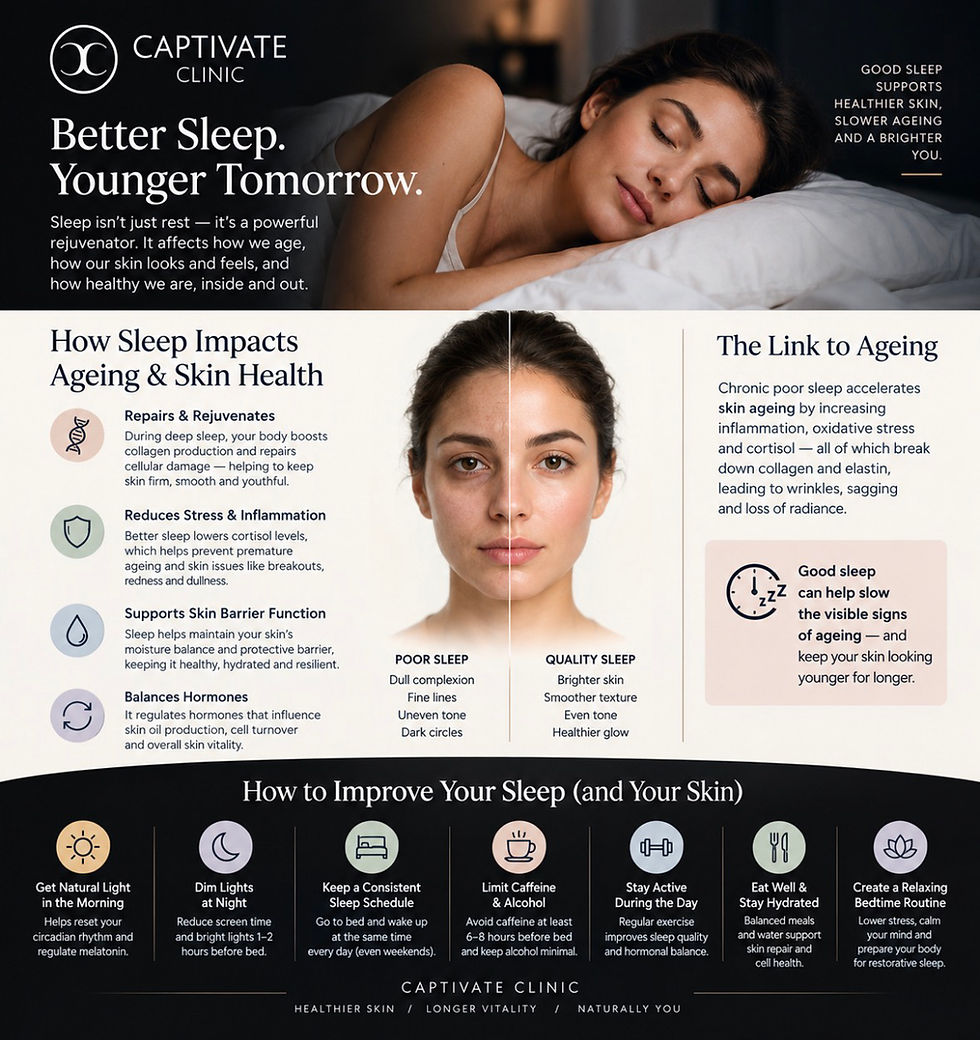
5. Exercise supports better sleep
Sleep is an essential component of recovery.
During sleep, the body undertakes important processes involved in tissue maintenance, immune regulation and overall recovery.
Regular physical activity is associated with improved sleep and may therefore indirectly support healthy skin and healthy ageing. Current reviews examining lifestyle factors and skin ageing also identify sleep and stress as important contributors to skin health.
6. Strength training becomes increasingly important as we age
Cardio gets a lot of attention, but strength training deserves equal consideration.
As we age, maintaining muscle mass, strength, bone health and functional capacity becomes increasingly important.
Resistance training can help support muscle strength and physical function, while weight-bearing and strengthening activities contribute to musculoskeletal health.
This matters for healthy ageing far beyond appearance.
A strong body is a more resilient body.
And maintaining muscle and physical function can help us remain independent and active as we get older.
What about collagen?
Collagen is one of the major structural proteins in the skin and plays an important role in skin strength and structure.
There is growing interest in whether lifestyle factors, including physical activity, may influence collagen-related pathways and the dermal environment.
However, it is important not to overstate the evidence.
Exercise should not be presented as a guaranteed method of increasing skin collagen or reversing wrinkles.
Research examining the relationship between physical activity and skin ageing is promising, but much of the evidence is still developing and includes observational studies, mechanistic research and narrative reviews.
Healthy ageing is multifactorial.
Exercise is one piece of the puzzle — not the entire puzzle.
Does sweating detox your skin?
This is a common misconception.
Sweating is primarily a mechanism used by the body to regulate temperature.
Your liver and kidneys play the major roles in processing and eliminating many metabolic waste products.
So while sweating during exercise is completely normal and important for temperature regulation, it isn't accurate to describe a workout as "detoxing" your body through sweat.
And there is another reason to pay attention to your skin after exercising.
Sweat can mix with oil, makeup, sunscreen, bacteria and environmental debris. For some people, leaving this mixture on the skin for prolonged periods may contribute to irritation or breakouts.
A gentle cleanse after exercise can therefore be a useful part of your skincare routine, particularly if you are prone to acne or irritation.
Exercise and sun protection: an important combination
If you exercise outdoors, sun protection becomes particularly important.
Regular physical activity may support healthy ageing, but repeated ultraviolet exposure is one of the major environmental contributors to premature skin ageing.
So if you're walking, running, cycling, swimming or playing sport outdoors, don't forget the basics:
Apply broad-spectrum sunscreen.
Reapply when appropriate, particularly with prolonged outdoor activity, sweating or swimming.
Wear protective clothing where practical.
Use a hat and seek shade when appropriate.
Consider the UV index when planning outdoor exercise.
Exercise should be part of your healthy-ageing strategy — not a reason to neglect sun protection.
Is there a difference between exercise for women and men?
The fundamental physical activity recommendations are not divided into separate exercise targets simply becausesomeone is male or female.
For most adults, the same general evidence-based targets apply.
However, individual exercise needs can vary considerably according to age, fitnesslevel, pregnancy or postpartum status, medical conditions, injuries, medications, goals and previous exercise experience.
A personalised exercise program may thereforelook very different from person to person.
The most effective program is one that is appropriate for the individual and can be performed safely and consistently.
What types of exercise should you consider?
There is no single "best" exercise for healthy ageing.
A balanced approach might include:
Cardiovascular exercise
Walking, jogging, cycling, swimming, dancing or other aerobic activities can help improvecardiovascular fitness.
Resistance training
Weights, resistance machines, bodyweight exercises and resistance bands can help maintain and build muscle strength.
Mobility and flexibility
Yoga, Pilates, stretching and mobility exercises can help support movement and physical function.
Balance and functional exercise
Particularly as we get older, exercisesthat challenge balance, coordination and functional movement become increasinglyvaluable.
Everyday movement
Don't underestimate walking and general daily activity.
Physical activity doesn't have to happenin a gym to count. WHO emphasises that movement can come from transportation, work, household activities, recreation, sport and planned exercise.
The real healthy-ageing formula
If your goal is to age well, think beyond skincare alone.
A comprehensive approach includes:
MOVE YOUR BODY.
Build and maintain muscle.
Protect your skin from ultraviolet radiation.
Eat a balanced, nutrient-rich diet.
Prioritise adequate sleep.
Manage chronic stress.
Avoid smoking.
Limit excessive alcohol consumption.
Look after your cardiovascular and metabolic health.
And maintain a consistent skincare routineappropriate for your individual skin.
There is no single cream, treatment, supplementor workout that can stop the ageing process.
Ageing is biological and inevitable.
But how we age — and how healthy we remainalong the way — is influenced by many factors.
Exercise is one of the simplest and most powerful foundations we can build.
You don't have to destroy yourself to age well
More is not always better.
Extreme exercise without adequate recovery can place additional stress on the body, and very strenuous exercise may have different effects from moderate, sustainable activity. Recent research continues to investigate thepotential effects of excessive or exhaustiveexercise when recovery is inadequate.
You don't need to train like an elite athlete.
You don't need to exercise every day.
And you don't need to punish yourself for missing a workout.
What matters most is creating a sustainable pattern of movement that you can maintain for years and decades.
Start where you are.
Move more.
Get stronger.
Recover well.
Stay consistent.
Because healthy ageing isn't about trying to look 25 forever.
It's about supporting your body so you can feelstrong, capable and well for as long as possible.
And yes — that may show on your skin too.
CAPTIVATE CLINIC
Invest in your body. It shows on your skin.
Medical Disclaimer
The information provided in this article is for general educational and informationalpurposes only and is not intended to replace individual medical advice, diagnosis or treatmentfrom a qualified healthcare professional.
Exercise and lifestyle changes can providesignificant health benefits, but individual resultsvary. Skin health, appearance and the rate of ageing are influenced by many factors, including genetics, age, hormones, sun exposure, medical conditions, medications, nutrition, sleep, stress, lifestyle and environmental factors.
The information discussed above describes potential associations and benefits of physical activity and should not be interpreted as a guarantee that exercise will prevent, reverse or treat wrinkles, pigmentation, skin laxity or any other skin condition.
Before beginning a new exercise program, particularly if you have an existing medicalcondition, injury, are pregnant or postpartum, take regular medication, or have been physically inactive, seek appropriate advice from your doctor or qualified healthcare professional.
If you have a persistent, changing or concerning skin lesion or symptom, consult a qualified medical practitioner or dermatologist for assessment.
Any cosmetic or medical treatment discussed by Captivate Clinic should be consideredon an individual basis following appropriate consultation
and assessment.
Individual treatment outcomes vary and no result can be guaranteed.

and assessment.
Individual treatment outcomes vary and no result can be guaranteed.

Comments